
Last Updated: November 7, 2026
Quick Summary
Linen is generally regarded as one of the most breathable fabrics for hot, humid weather, followed by lightweight cotton and open-knit cotton blends. For big guys, weave and fit matter as much as fiber, so choose open weaves, pique or mesh knits, lightweight fabric under roughly 4 oz/yd², and a roomy cut that keeps cloth off the skin.
- Linen's hollow fibers and open weave let heat escape and dry faster than cotton.
- Hold fabric up to the light: if light passes through, air will pass through too.
- Pique polos feel cooler than flat jersey because texture lifts fabric off the skin.
- A tight shirt in a breathable fiber can feel hotter than a relaxed shirt in a heavier one.
- Save performance synthetics for active days and look for odor-control treatments.
Table of Contents
- Why Breathable Fabrics Matter More for Big Guys
- What Makes a Fabric Breathable: Weave, Weight, and Fiber
- The Most Breathable Fabric for Summer: Ranking the Fibers
- Moisture-Wicking Fabrics for Men: When Synthetics Beat Natural Fibers
- Natural Versus Synthetic Fibers: Sweat, Humidity, and Odor Control
- Breathable Summer Shirts for Big Men: Fit and Construction Beyond Fiber
- Pensacola Heat and Humidity: What to Wear on the Gulf Coast
- Fabric Care and Wear-Life Tradeoffs
- Try On Breathable Fabrics in Person at Lil' John's in Pensacola
- Frequently Asked Questions
Why Breathable Fabrics Matter More for Big Guys
Finding the best breathable fabrics for big guys is not a style preference. It is the difference between a comfortable day and a miserable one. A larger frame produces more body heat and traps more of it against the skin, so the fabric you wear has to move moisture and let air pass through far more efficiently than it does on a smaller body. At Lil' John's Big & Tall Men's Fashion in Pensacola, FL, we fit men in regular and big & tall sizes.
Fiber rankings alone leave out weave, weight and fit. A heavy cotton shirt and a light open-knit cotton shirt are made from the same fiber and feel nothing alike in Gulf Coast humidity. Below, we break down what actually makes a fabric breathe, rank the fibers honestly, and explain how construction and fit change the answer for a bigger build.
What Makes a Fabric Breathable: Weave, Weight, and Fiber
Breathability is the ability of a fabric to let air and water vapor pass through it, and it depends on three things working together: the fiber, the weave or knit, and the fabric weight. Fiber gets all the attention, but the other two often decide whether a shirt feels cool or clammy. A heavyweight cotton twill and a featherweight cotton poplin share a fiber and feel nothing alike in Gulf Coast humidity.
Think of it as a hierarchy. The weave sets the ceiling on airflow. The weight determines how much heat the garment holds. The fiber decides how the fabric handles sweat once it is on your skin. Get any one of them wrong and the shirt disappoints, no matter how good the fiber sounds on the label.
Fabric Weight and Lightweight Construction
Lighter fabric holds less heat and drapes with more airflow around the body. A mid-weight oxford and a featherweight poplin are both cotton, but only one belongs in a Pensacola July. Fabric weight is usually expressed in ounces per square yard (oz/yd²) or grams per square meter (GSM). As a rough guide, shirting under about 4 oz/yd² (roughly 135 GSM) sits in lightweight territory, while 5-7 oz/yd² is mid-weight and anything above that leans toward cool-weather wear. You do not need to memorize numbers, but the label or hangtag often gives you a clue, and lighter almost always wins in humidity.
Airflow, Open Knits, and Ventilation
Open weaves and knits create physical gaps that let air move. Mesh knits, pique knits and loose plain weaves all ventilate better than a tight, dense twill. When you shop, hold the fabric up to the light. If you can see it pass through, air will pass through too. Construction names are worth learning because they tell you more than the fiber list does:
- Poplin: a smooth, tight plain weave. Crisp and dressy, but less airy than an open weave; better for air-conditioned days than a midday walk.
- Pique: a textured knit with small raised cells, the classic polo construction. The texture lifts fabric off the skin and creates tiny channels for air, which is why a pique polo feels cooler than a flat jersey polo of the same weight.
- Mesh: an open knit with visible holes. Maximum ventilation, often used in athletic and travel shirts, though it can look casual.
- Oxford: a basket-weave cotton, durable and slightly textured. Fine for spring and fall, warm for peak summer.
- Twill: a dense diagonal weave, common in trousers and heavier shirts. Durable and wrinkle-resistant, but the tight structure limits airflow.
- Seersucker: a puckered weave that holds fabric away from the skin, creating air pockets. A traditional hot-climate choice for good reason.
How Fit and Cling Undermine a Breathable Fabric
Even an open weave cannot help if the garment is plastered to your body. A shirt that is tight across the chest and arms blocks airflow and traps heat against the skin, and clingy fabric holds sweat in place instead of letting it evaporate. A roomy cut with a generous sleeve and a little ease through the torso lets air circulate. This matters more for bigger frames, where more skin is in contact with fabric and more heat is generated. The table below summarizes how the factors interact.
| Factor | What It Controls | What to Look For |
|---|---|---|
| Fiber | How sweat is handled | Linen, cotton, or a performance blend |
| Weave or knit | Airflow ceiling | Open plain weave, pique, mesh knit, seersucker |
| Fabric weight | Heat retention | Lightweight, under roughly 4 oz/yd² for summer |
| Fit | Air circulation | Roomy through chest, stomach, underarms, and sleeves |
Watch out: a tight-fitting shirt in a breathable fiber can feel hotter than a relaxed shirt in a slightly heavier one, because trapped air and sweat matter more than the fiber label.
The Most Breathable Fabric for Summer: Ranking the Fibers
Linen is generally regarded as one of the most breathable summer fabrics, followed by lightweight cotton and open-knit cotton blends. Linen's irregular fiber structure and loose weave let air pass easily, and it absorbs moisture without clinging. Cotton is the close second, especially in a lightweight weave or a knit.
Merino wool deserves a mention for travel and evening wear. Fine-gauge merino regulates temperature and resists odor, though it costs more and feels warmer than linen at midday. Rayon and silk drape well and feel cool to the touch, but they show sweat and demand careful washing. Nylon and polyester, in their basic forms, trap heat. Engineered performance versions are a different story, which we cover below.
Linen and Its Cooling Properties
Linen cools because its fibers are hollow and its weave is open, so heat escapes and air circulates. It also wicks moisture away from the skin and dries faster than cotton. The tradeoff is wrinkles, which is a fair price for comfort in real humidity. If you want to see how the fabric actually wears, browse our John Edwin Linen Shirts.

Cotton and Cotton Blends
Cotton is the workhorse. It is soft, breathable, and easy to care for, and combed cotton in a lightweight knit feels cool against the skin. Blends add stretch, shape retention or wrinkle resistance. A cotton-poly blend will resist creasing better than pure cotton, though it breathes a little less. For everyday heat, our Greystone 100 Cotton T Shirts Lighter Colors show how a lighter color and a light knit work together.

Moisture-Wicking Fabrics for Men: When Synthetics Beat Natural Fibers
Synthetics win when the goal is drying fast, not staying cool. Engineered polyester and nylon move sweat to the surface of the fabric where it evaporates quickly, which is why athletic wear leans on them. In high humidity, a performance fabric can feel drier than cotton because it does not hold moisture against the skin.
Our Tommy Bahama Palm Coast Pro Polo is built for exactly that kind of hot, humid day.
Natural Versus Synthetic Fibers: Sweat, Humidity, and Odor Control
Natural fibers breathe and handle odor better. Synthetic fibers dry faster and hold their shape. In Gulf Coast humidity, the honest answer is that you want both in your closet, chosen by activity rather than ideology.
- Linen: best airflow, wrinkles, dries reasonably fast
- Cotton: comfortable and breathable, holds moisture longer
- Merino wool: temperature-regulating and odor-resistant, costs more
- Rayon and silk: cool to the touch, delicate care
- Performance polyester and nylon: fastest drying, needs odor control
Watch out: a cheap polyester shirt with no wicking treatment is the worst of both worlds. It traps heat and holds odor. Check for a performance or moisture-wicking label before you buy.
Breathable Summer Shirts for Big Men: Fit and Construction Beyond Fiber
Fit changes breathability more than most men realize. A shirt that is tight across the chest and arms blocks airflow and traps heat against the body. A roomy cut with a generous sleeve and a little ease through the torso lets air circulate and lets sweat evaporate.
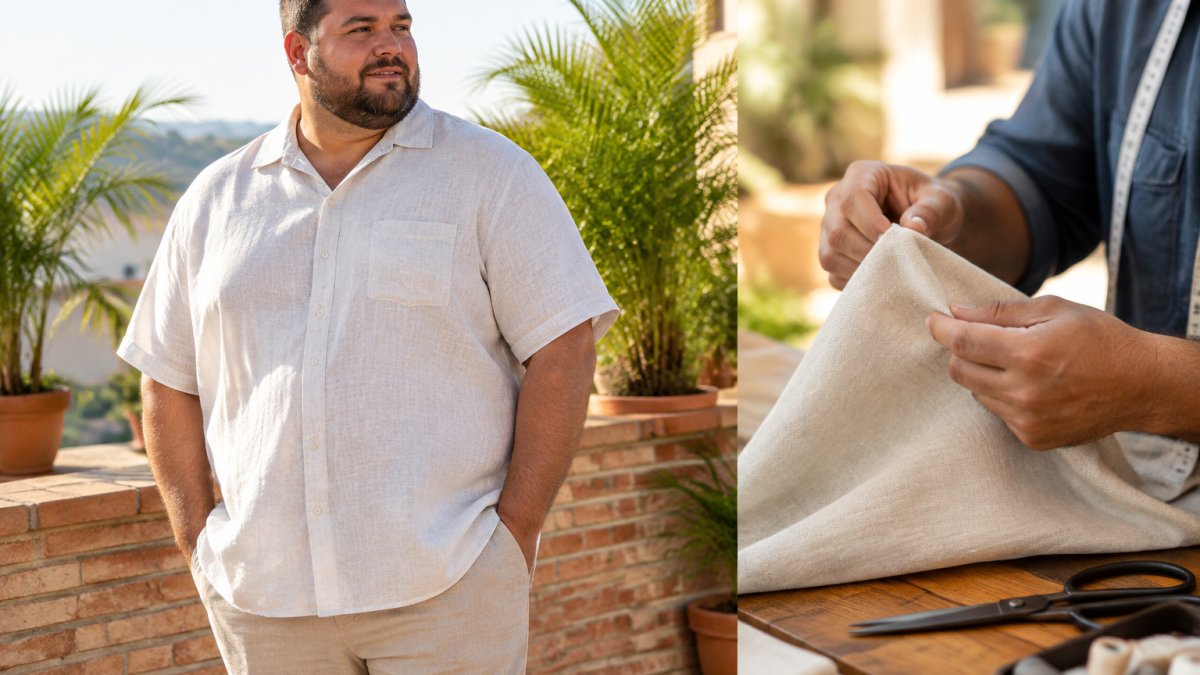
Construction matters too. Look for a straight hem you can wear untucked, a collar that stands off the neck, and side vents on button-downs. Big and tall sizing should add length in the body and sleeve, not just width, so the shirt does not ride up. If you are building a full outfit, our Grand River Lightweight Stretch Twill Pant Big Men 28 30 32 Inseam 283 pairs a lightweight stretch twill with the big and tall sizing a taller frame needs.

Best for: men who run hot and want airflow through the torso and sleeves. Skip if: you prefer a slim, close cut and do not mind a warmer feel.
Pensacola Heat and Humidity: What to Wear on the Gulf Coast
Pensacola summers combine high heat with heavy humidity, and that combination changes how your body cools itself. In dry heat, sweat evaporates quickly and carries heat away with it. In Gulf Coast humidity, the air is already close to saturated, so sweat evaporates slowly and instead sits on the skin. That is why the same shirt that feels fine in a dry climate can feel clammy here by mid-morning. The practical takeaway: in Pensacola you want fabrics and constructions that either move moisture away from the skin fast or let maximum air through, and you want to avoid heavy, tight weaves entirely.
Most summer guides rank fibers and stop there. Locally, the weave and the fit often matter more than the fiber, because the goal is to keep fabric off your skin and let air move. A loose seersucker or open pique shirt will outperform a tight, smooth poplin on a humid afternoon, even though poplin is a fine hot-weather fabric on paper.
Practical rules for dressing here:
- Choose linen, seersucker, or lightweight open-weave cotton for daytime errands and outdoor plans.
- Favor pique and mesh knits over flat jersey for polos and tees; the texture lifts fabric off the skin.
- Save performance synthetics for active days when fast drying matters most, and look for odor-control treatments.
- Wear lighter colors, which absorb less heat and show sweat less than dark shades.
- Keep a breathable layer for air-conditioned rooms and evening storms, when temperatures drop but humidity lingers.
- Avoid heavy twills, dense oxfords, and any shirt that clings across the chest or underarms.
A useful local habit is to check the heat index rather than the temperature alone. When the heat index climbs well above the air temperature, evaporation is slow and breathable, loose construction matters more than ever. On those days, a relaxed linen shirt and lightweight trousers will keep you more comfortable than any technical fabric worn tight.
If you are planning around the change of season, our guide to what to wear for fall in Florida covers how to layer lightly when the humidity finally breaks.
Fabric Care and Wear-Life Tradeoffs
Every breathable fabric asks something of you in return. Linen wrinkles and softens with washing, which many men come to prefer. Cotton can shrink unless it is pre-shrunk or combed, so check the care label. Merino needs gentle washing and air drying. Performance synthetics last well but can hold odor if you wash them in cold water with heavy detergent residue.
A simple care routine extends the life of breathable clothing:
- Wash linen and cotton in cool water and hang to dry
- Skip the dryer for linen to limit shrinkage and wear
- Air out performance fabrics between wears
- Use less detergent than the bottle suggests to avoid residue buildup
The tradeoff is worth naming. Linen wrinkles readily and asks for a relaxed attitude toward creasing. Cotton gives you easy care and slightly less airflow. Synthetics give you fast drying and ask for odor management.
Try On Breathable Fabrics in Person at Lil' John's in Pensacola
Reading about fabric is useful. Feeling it against your skin in the store is better. Lil' John's Big & Tall Men's Fashion specializes in men's clothing in regular sizes and big & tall sizes, with a full alterations department for men's, women's and children's clothing alterations. We also specialize in men's custom clothing.
Come in and compare linen, cotton and performance fabrics side by side. Our team can help you build a summer wardrobe that fits your frame and the Pensacola climate, from breathable shirts to lightweight trousers and custom pieces.
The heat and humidity here are not going anywhere, and neither is the need for clothing that works with your body instead of against it. Lil' John's Big & Tall Men's Fashion can help you build a wardrobe around breathable fabrics, with big and tall sizing, a full alterations department, and custom clothing made to your measurements. Get started with Lil' John's Big & Tall Men's Fashion and dress cooler through every Pensacola summer.
Frequently Asked Questions
What is the coolest, most breathable fabric for a big guy?
Linen is a popular choice for warm weather. Its loose weave lets air move through the cloth, and the fiber absorbs sweat and releases it quickly, so the fabric dries instead of clinging. Pure linen shirts, like the Proper Sport Pure Linen Contemporary fit LS Shirt, work well for warm-weather office days and weekends. If you want more stretch and wrinkle resistance, a cotton-polyester blend with a linen look is a practical second choice.
Is cotton or linen more breathable for summer?
Cotton is softer and cheaper, and a lightweight cotton or combed cotton tee still breathes well. For a big frame in high humidity, linen wins on drying speed and cling resistance. Cotton blends with a bit of stretch are the better pick when you need shape retention for a full day at work.
Are moisture-wicking fabrics good for big guys?
Yes, with a caveat. Moisture-wicking fabrics for men pull sweat away from the skin and dry fast, which helps when you run hot. The catch is odor: synthetics hold bacteria more than natural fibers unless they are treated. Look for blends that pair polyester with cotton or merino, and wash them promptly. For everyday wear in Pensacola humidity, a wicking undershirt under a linen or cotton button-down gives you the best of both.
What fabrics should a big guy avoid in hot weather?
Skip heavy denim, tight-knit polyester, and thick wool suiting in the heat. These trap air and moisture against the body, which leads to cling and visible sweat. Also avoid stiff, non-breathable dress shirts cut slim through the chest and arms. If you need a suit for a summer event, choose a lightweight fabric suited to warm weather.
How should a big guy choose a breathable shirt?
Start with the fiber: linen, lightweight cotton, or a moisture-wicking blend. Then check the weave and weight. An open weave and a lighter fabric weight breathe better. Finally, look at the cut. A shirt that is too tight blocks airflow and shows sweat; one that is too loose billows and traps heat. A contemporary or relaxed fit through the chest and arms, with a hem long enough to tuck, is the sweet spot for big and tall frames.

0 comments