
How Much Do Men’s Alterations Typically Cost? A Simple Tailoring Price Guide
You find a suit you love.
The shoulders look great.
The color is perfect.
But the sleeves are a little long.
Or maybe your new trousers fit perfectly through the waist but need to be shortened.
So now comes the question:
How much are alterations actually going to cost?
The answer depends on what needs to be changed.
Some alterations are relatively simple and inexpensive. Others require taking apart significant portions of a garment and can become considerably more expensive.
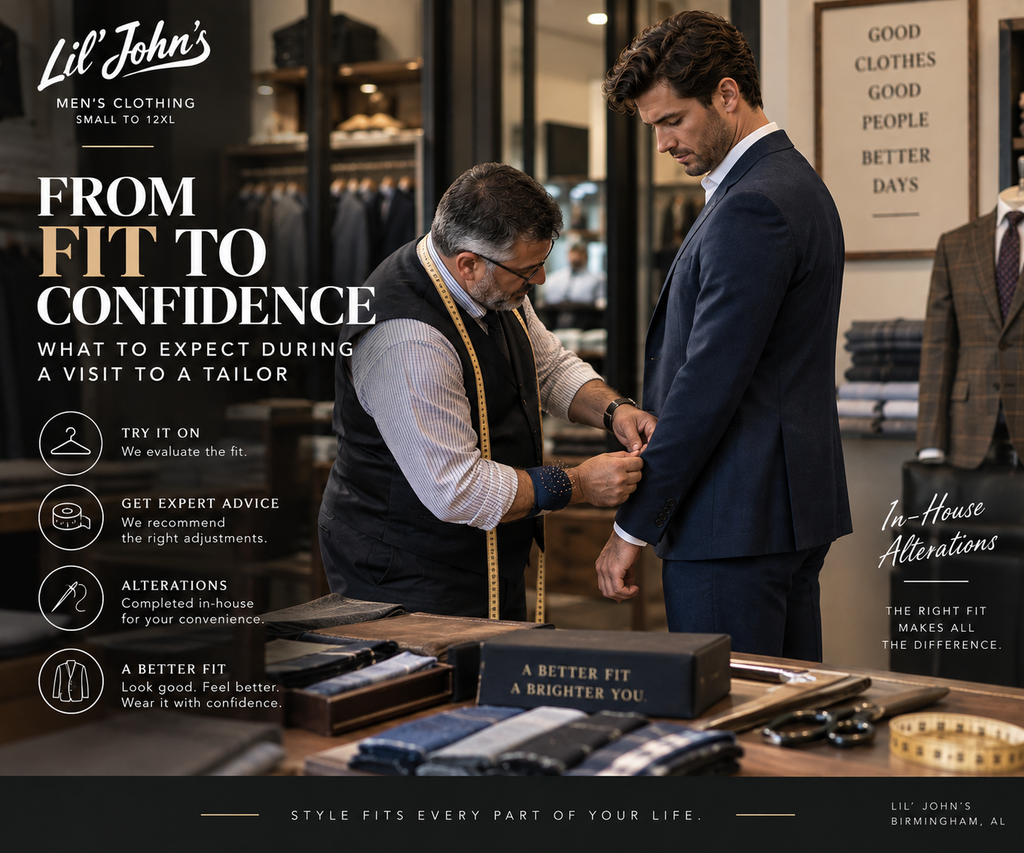
At Lil’ John’s, we believe fit is one of the most important parts of looking good in your clothes. We carry men’s clothing from Small through 12XL, and we also offer in-house alterations to help you get the fit right without having to search for a tailor somewhere else.
Because sometimes finding the right size is only the beginning.
Here’s a simple guide to what men’s alterations typically cost, which adjustments may be worth considering, and how Lil’ John’s can help you get the fit you’re looking for.
A quick note: The prices in this guide are general alteration estimates and are not a guaranteed Lil’ John’s price list. Alteration costs vary depending on the garment, fabric, construction, and amount of work required. Ask us about your specific garment for more information about alteration options and pricing.
Lil’ John’s Offers In-House Alterations
One of the advantages of shopping at Lil’ John’s is that finding your clothes and getting the fit right can happen in the same place.
We offer in-house alterations to help fine-tune the fit of your clothing.
Maybe your suit jacket fits perfectly through the shoulders but the sleeves need adjusting.
Maybe your trousers need to be hemmed.
Maybe the waist needs some attention.
Instead of settling for something that is simply “close enough,” alterations can help take a garment that already fits well and make it fit even better.
And because our team works with men across a wide range of sizes, from Small through 12XL, we understand that fit is not one-size-fits-all.
Different builds require different adjustments.
The goal is simple:
Find the closest fit first. Then fine-tune the details.
Why Do Alteration Prices Vary So Much?
Two pairs of pants might look almost identical but require very different amounts of work.
Alteration pricing can depend on:
The garment
The fabric
How the garment is constructed
How much needs to be changed
Whether lining needs to be removed
Whether buttons, pockets, or zippers are involved
The complexity of the alteration
The more of the garment that needs to be taken apart and reconstructed, the more you should generally expect the alteration to cost.
How Much Does It Cost to Hem Men’s Pants?
This is one of the most common alterations.
If your trousers fit correctly through the waist and legs but are simply too long, hemming can usually solve the problem.
A typical basic trouser hem may cost approximately:
$15 to $30
More complicated hems or specialty finishes may cost more.
Before having your pants hemmed, wear the shoes you expect to wear with them.
Why?
Because your shoes affect where the trousers should fall.
Remember our guide to trouser break?
This is where it matters.
You can choose:
No break
Slight break
Half break
Full break
For many men, a slight break is a versatile place to start.
How Much Does It Cost to Take In the Waist of Pants?
If your pants fit through the legs but feel loose around the waist, an alteration may be able to improve the fit.
A typical range might be:
$20 to $45
The exact cost depends on the construction of the trousers and how much adjustment is needed.
If the waist needs to change dramatically, the alteration can become more complicated because the seat and overall proportions may also need adjustment.
This is why it is always better to start with pants that fit reasonably close to your body.
How Much Does It Cost to Taper Pants?
Maybe your trousers fit through the waist but feel too wide through the legs.
Tapering can create a cleaner silhouette.
Depending on how much work is needed, expect approximately:
$25 to $60
If the pants need to be tapered through both the thigh and lower leg, the price may be higher.
Remember:
Tapered does not mean tight.
The goal is usually to create a cleaner line while still giving you enough room to sit, walk, and move comfortably.
How Much Does It Cost to Shorten Suit Jacket Sleeves?
Jacket sleeve alterations are extremely common.
A basic sleeve adjustment may cost approximately:
$30 to $70
But this one can become more expensive.
Why?
Because some jackets have:
Buttons
Buttonholes
Working sleeve buttons
Decorative stitching
Lining
If the jacket has functioning buttonholes, shortening the sleeve from the cuff can be more difficult. In some cases, more extensive work may be required.
How Long Should Your Jacket Sleeves Be?
When your arms are relaxed, your jacket sleeves should generally allow a small amount of your dress shirt cuff to show.
A common guideline is around:
¼ to ½ inch of shirt cuff
You do not need to measure yourself every morning.
The goal is simply to create a clean visual separation between your jacket sleeve and your hand.
If your jacket completely covers your shirt cuff and extends onto your hand, the sleeves may be too long.
How Much Does It Cost to Take In a Suit Jacket?
If your jacket fits through the shoulders but feels too loose through the waist or body, taking it in may create a cleaner silhouette.
Depending on the construction and amount of work, this might cost approximately:
$40 to $100 or more
Taking in the sides of a jacket is more involved than hemming pants.
The proportions of the garment need to remain balanced while creating a cleaner fit through the body.
The more complicated the jacket construction, the more expensive the alteration can become.
How Much Does It Cost to Shorten a Suit Jacket?
This is where things become more complicated.
Shortening the actual body length of a suit jacket can cost approximately:
$60 to $150+
And it is not always recommended.
Why?
Because changing jacket length can affect:
Pocket placement
Button position
Overall proportions
Jacket balance
A jacket shortened too aggressively can look strange even if the tailoring itself is technically well done.
This is why getting the jacket length reasonably correct from the beginning is important.
What About Altering the Shoulders?
Shoulder alterations are among the most complicated changes that can be made to a suit jacket.
Depending on the jacket and work required, shoulder alterations can easily cost:
$75 to $200+
Sometimes considerably more.
And even then, the result may not be worth the cost.
That is why we consistently emphasize one rule when buying a suit:
Get the shoulders right first.
A lot of things can be adjusted.
Sleeves can be shortened.
Waists can be taken in.
Trousers can be hemmed.
But rebuilding the shoulders of a jacket can become complicated and expensive very quickly.
Start with a jacket that fits properly through the shoulders whenever possible.
How Much Do Shirt Alterations Cost?
Dress shirts can also be altered.
Common adjustments may include:
Shortening Sleeves
Approximately $20 to $40
Taking In the Body
Approximately $20 to $45
Shortening Shirt Length
Approximately $20 to $40
Prices depend on the shirt, its construction, and the amount of work involved.
There is also a point where extensive alterations to an inexpensive shirt may cost almost as much as simply starting with a better-fitting shirt.
That is another reason why finding the closest possible fit from the beginning matters.
How Much Do Jeans Alterations Cost?
Jeans can often be adjusted just like trousers.
A basic hem might cost:
$15 to $30
A specialty or original hem may cost:
$25 to $50
Tapering may cost:
$25 to $60
Waist adjustments can vary depending on the construction.
At Lil’ John’s, our denim selection includes brands such as Grand River and Tommy Bahama, giving men options for different fits and styles.
Ideally, your jeans should already fit properly through the waist, seat, and thighs.
Then smaller adjustments can help fine-tune the fit.
A Quick Men’s Alteration Cost Guide
Here is a simple general reference:
Hem trousers: $15–$30
Take in trouser waist: $20–$45
Taper trousers: $25–$60
Shorten jacket sleeves: $30–$70+
Take in jacket body: $40–$100+
Shorten jacket length: $60–$150+
Alter jacket shoulders: $75–$200+
Shorten shirt sleeves: $20–$40
Take in shirt body: $20–$45
Hem jeans: $15–$30
Original jean hem: $25–$50
Again, these are general estimates only, not guaranteed Lil’ John’s alteration prices.
For specific pricing, ask us about the garment and alteration you need.
Which Alterations Are Usually Worth It?
Some alterations can make a dramatic difference without completely rebuilding the garment.
Good candidates often include:
Hemming trousers
Adjusting trouser waist
Light trouser tapering
Shortening sleeves
Taking in the body of a jacket
Taking in a shirt
These adjustments can turn a garment that is already close into something that looks much more intentional.
Which Alterations Can Become Expensive?
Be more cautious when you start changing:
Jacket shoulders
Major jacket length
Large changes to the chest
Major changes to trouser rise
Extensive resizing
At some point, you are no longer fine-tuning the garment.
You are practically rebuilding it.
And once you reach that point, starting with a different size or garment may make more sense.
The Most Important Rule: Buy for the Hardest Area to Alter
When buying a suit jacket, prioritize:
The shoulders.
When buying trousers, prioritize:
The waist, seat, and overall rise.
When buying a shirt, prioritize:
The collar, shoulders, and chest.
You want the difficult areas to fit as closely as possible from the beginning.
Then use alterations for the smaller adjustments.
That approach usually gives you a better result and helps keep alteration costs under control.
Do Not Automatically Size Up
This is especially important for Big & Tall men.
If one area feels tight, the solution is not always to jump several sizes larger.
A much larger garment may fix one problem while creating five new ones.
The shoulders become too wide.
The sleeves become too long.
The body becomes too loose.
The trousers become too wide.
Now you need far more alterations.
Instead, find the size and cut that matches your proportions as closely as possible.
The closer you start, the less that needs to be changed.
Are Alterations Worth the Money?
For the right garment?
Absolutely.
Imagine two suits.
One costs $500 and fits poorly.
The other costs $400, plus some alterations, and fits beautifully.
Which one is going to look more expensive?
Usually, the one that fits.
The price on the tag does not determine how good clothing looks on you.
Fit does.
That does not mean every garment needs alterations.
But making a few adjustments to something you will wear for years can be money well spent.
Alterations Can Make Your Existing Wardrobe Better
You also do not necessarily need to buy something new.
Look through your closet.
Maybe you already own:
A suit with sleeves that are too long.
Dress pants that need hemming.
A sport coat that feels slightly loose.
A pair of jeans that would look better with a cleaner taper.
A shirt that has too much fabric around the waist.
Sometimes the wardrobe upgrade you need is already hanging in your closet.
It just needs a better fit.
Fit Is an Investment
Alterations are not about making every piece of clothing skin-tight.
They are about proportion.
Your sleeves should end where they should.
Your trousers should meet your shoes correctly.
Your jacket should follow your body.
Your pants should stay at your waist.
And you should still be able to move comfortably.
Those small adjustments can completely change how an outfit looks.
Find the Right Fit at Lil’ John’s
At Lil’ John’s, we do not want to simply help you find clothes you like.
We want to help you find clothes that fit.
That is why, in addition to carrying men’s clothing from Small through 12XL, Lil’ John’s offers in-house alterations to help fine-tune your fit.
From suits and sport coats to dress shirts, trousers, jeans, polos, shoes, and everyday essentials, our goal is to make finding the right look easier from start to finish.
Sometimes the right size fits perfectly straight off the rack.
Sometimes a hem, sleeve adjustment, or another alteration makes the difference.
Either way, start with the garment that fits you as closely as possible.
Then let the details bring everything together.
Because a great outfit is not about the number on the tag.
It is about how it fits when you put it on.
Lil’ John’s — The sizes you need. The style you want. The fit you deserve.







Comments