
What to Expect During a Visit to a Tailor: A Men’s Guide to Alterations
You finally decide to get that suit altered.
Then you realize:
You have absolutely no idea what happens at a tailor.
Do you need an appointment?
What should you bring?
Do you wear the shoes?
Are they going to take measurements?
How do you explain what you want?
And what happens if you do not even know what needs to be changed?
If you have never had clothing professionally altered before, the process can sound much more complicated than it actually is.
At Lil’ John’s, we carry men’s clothing from Small through 12XL, and we also offer in-house alterations to help fine-tune your fit.
Whether you are getting ready for a wedding, updating a suit, hemming a pair of trousers, or simply trying to make your everyday clothes fit better, here is what you can expect during the alteration process.
First, You Do Not Need to Know Tailoring Terminology
This is probably the biggest thing to understand.
You do not need to walk in saying:
"I need the jacket suppressed through the waist and the trousers tapered below the knee with a slight break."
If you know exactly what you want, great.
If you do not, that is completely fine too.
You can simply say:
“Something about this doesn't fit right.”
Or:
“I think these sleeves are too long.”
Or:
“I want these pants to look a little cleaner.”
A fitting is partly about identifying what can be adjusted to improve the garment.
Your job is to explain how the clothing feels and how you would like it to look.
Step 1: Try On the Garment
The first part of most fittings is simple.
You put the clothing on.
This allows the fit to be evaluated on your body, which is completely different from looking at the garment on a hanger.
For a suit, this might mean trying on:
The jacket
Trousers
Dress shirt
Shoes
For pants, you may simply need to put on the trousers with the shoes you plan to wear.
Once the garment is on, the fit can be evaluated properly.
Step 2: The Overall Fit Is Evaluated
Before making changes, it is important to look at the entire garment.
For a jacket, attention may be given to:
Shoulders
Chest
Waist
Jacket length
Sleeve length
Collar
Back
For trousers:
Waist
Seat
Thighs
Rise
Leg width
Inseam
Trouser break
The goal is not to make everything tighter.
The goal is to make everything proportional.
Step 3: You Will Be Asked How You Want It to Fit
Fit is partly technical.
But it is also personal.
Some men prefer a more traditional fit.
Others prefer something more tapered and modern.
Some want extra room through the legs.
Others want a cleaner silhouette.
This is why communication matters.
You may be asked questions such as:
Do you like your trousers slimmer or more relaxed?
How much break do you want over your shoes?
Do you normally wear this jacket buttoned?
Do you want more room through the waist?
Does anything feel uncomfortable when you move?
There is not always one universally correct answer.
The best alteration should work with both your proportions and your preferences.
Step 4: Measurements May Be Taken
Depending on the garment and alteration, measurements may be taken.
This can include areas such as:
Chest
Waist
Sleeve
Inseam
Trouser length
Seat
Shoulders
But measurements are only part of the process.
Two men can technically have similar measurements and still need clothing to fit differently because of posture, proportions, build, and personal preference.
That is why the garment is usually evaluated while you are actually wearing it.
Step 5: The Garment Is Pinned or Marked
This is the part most people picture when they think about tailoring.
Pins or markings may be used to show where fabric needs to be shortened, taken in, or adjusted.
For example, trousers might be pinned to determine the correct hem.
A jacket sleeve might be marked to determine the proper length.
The body of a jacket might be temporarily adjusted to show what a cleaner fit could look like.
This gives you a preview of the proposed change before the garment is altered.
Do Not Be Afraid to Speak Up During the Fitting
This is important.
If something feels too tight, say it.
If you prefer more room, say it.
If you do not like how short the trousers look, say it.
If you normally carry your phone or wallet in a particular pocket, mention it.
The goal is not simply to make the clothing technically correct.
The goal is to make it work for you.
A suit can look beautiful while you are standing perfectly still.
But you also need to:
Sit.
Walk.
Reach.
Move.
Live your life.
Good alterations should improve the fit without making the garment uncomfortable.
Move Around
Do not just stand like a mannequin during your fitting.
Move.
Sit down if appropriate.
Bend your arms.
Reach forward.
Walk around.
Button the jacket.
Put your hands in your pockets.
A garment needs to work while your body is moving.
Something that looks perfectly fitted while standing still may feel completely different when you sit down.
Bring the Shoes You Plan to Wear
If trousers are being hemmed, bring your shoes.
This is one of the most important things you can do.
Different shoes affect how trousers fall.
Loafers.
Oxfords.
Boots.
Sneakers.
They all create different proportions around the hem.
If you are having suit trousers altered for a wedding and already know which shoes you are wearing, bring them.
That makes it much easier to determine the correct trouser break.
Bring the Shirt You Plan to Wear With Your Suit
If your jacket sleeves are being adjusted, bring or wear the dress shirt you plan to wear underneath.
Why?
Because shirt sleeve length and jacket sleeve length work together.
Ideally, a small amount of shirt cuff should show below the jacket sleeve.
If your shirt sleeves are already too short, a correctly fitted jacket can appear too long.
Seeing the pieces together helps create a more accurate overall fit.
Bring the Accessories That Affect the Fit
You do not need to bring your entire closet.
But if something changes how the garment sits, bring it.
That might include:
Dress shoes
Dress shirt
Belt
Suspenders
Vest
Any other piece that is part of the outfit
If you are having a three-piece suit altered, for example, it makes sense to evaluate the pieces together.
What Should You Wear to a Fitting?
Wear clothing that makes changing easy.
If you are having a suit altered, a proper dress shirt is useful.
If you are having trousers hemmed, wear or bring the shoes you plan to use.
Avoid arriving in something that makes it difficult to accurately evaluate the garment.
The closer your fitting setup is to the way you will actually wear the outfit, the better.
What If You Are Having Clothes Altered for a Wedding?
Tell us.
Or any other important event.
The date matters.
If you need the garment for:
A wedding
Prom
Graduation
Business event
Vacation
Formal dinner
Church event
Holiday party
Special occasion
Make sure the timeline is known from the beginning.
That allows everyone to understand when the garment needs to be completed and whether enough time is available.
Do not assume every alteration can be completed overnight.
Ask What Is Actually Worth Altering
Just because something can potentially be altered does not mean it should be.
This is especially true with suit jackets.
Simple adjustments might make perfect sense.
Major reconstruction might not.
For example, changing:
Jacket shoulders
Major jacket length
Large portions of the chest
Major structural elements
can become complicated.
Sometimes the better answer is simply trying a different size or cut.
A good fitting is not about finding the maximum number of alterations possible.
It is about finding the smartest path to a better fit.
Start With the Hardest Areas to Alter
This is why we always recommend getting the difficult areas right first.
For a suit jacket:
Start with the shoulders.
For trousers:
Start with the waist, seat, and rise.
For a shirt:
Start with the collar, shoulders, and chest.
Then alterations can fine-tune areas like sleeve length, trouser length, waist shape, and other details.
Think of alterations as finishing work.
Not a way to completely rebuild the wrong size.
What Happens After the First Fitting?
Once the changes have been agreed upon, the garment is left for the alteration work to be completed.
The turnaround time depends on:
The garment
The type of alteration
How many adjustments are needed
The complexity of the construction
Current workload
Whether another fitting will be necessary
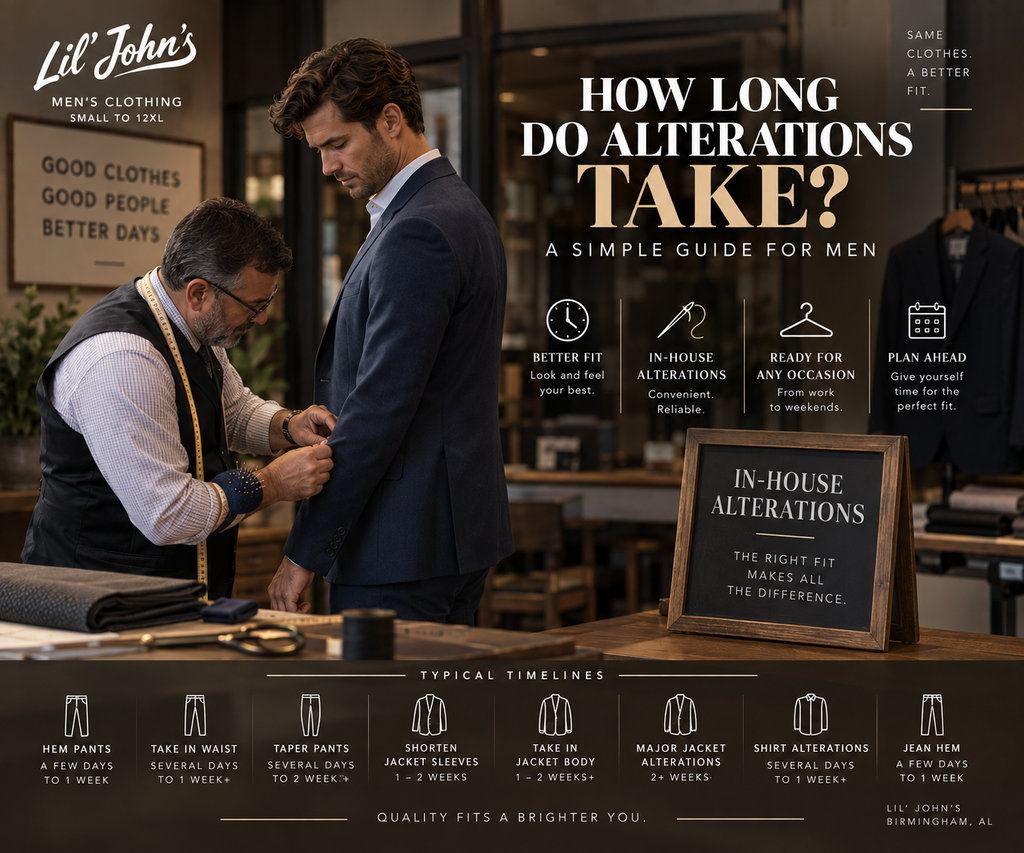
As we discussed in our alteration timeline guide, simple work may take several days while more involved alterations can take longer.
If you need the garment for a particular date, make sure that is discussed during the fitting.
Will You Need a Second Fitting?
Possibly.
For simple alterations, one fitting may be enough.
For more complicated work, you may need to try the garment on again.
This gives you a chance to check:
Sleeve length
Trouser length
Jacket shape
Waist
Comfort
Movement
Overall balance
Sometimes one adjustment slightly changes how another area sits.
A second fitting allows those final details to be addressed.
What Happens When You Pick It Up?
Do not simply grab the garment and leave.
Try it on.
Even if everything looks perfect on the hanger.
Put it on and check the fit.
For trousers:
Look at the waist.
Look at the hem.
Check the break over your shoes.
Walk around.
Sit down.
For a jacket:
Check the shoulders.
Button it.
Look at the sleeves.
Move your arms.
Look at the front and back.
This is your opportunity to make sure the finished garment feels the way you expected.
What If Something Still Doesn't Feel Right?
Say something.
Alterations are about fine-tuning.
If something does not feel or look the way you expected, communicate it.
Maybe the pants feel slightly too tight.
Maybe you wanted less trouser break.
Maybe the jacket waist feels too fitted.
It is much better to discuss the issue while you are trying the garment on than to take it home and never wear it.
How Much Will It Cost?
Alteration pricing depends on the work being performed.
A simple trouser hem is very different from restructuring a suit jacket.
The price can be affected by:
Garment construction
Fabric
Lining
Buttons and buttonholes
Amount of work
Number of alterations
Complexity
At Lil’ John’s, ask us about your specific garment and the alterations being considered so you can understand the options before the work is completed.
How Long Will It Take?
Again, it depends.
Some common alterations may be completed relatively quickly.
More complicated work requires additional time.
The safest approach is:
Do not wait until the last minute.
If you have an important event coming up, come in early.
Give yourself enough time for:
Shopping
The first fitting
Alterations
A possible second fitting
Final pickup
That removes a lot of unnecessary stress.
Big & Tall Alterations Are About Proportion, Not Just Size
This is particularly important for Big & Tall men.
Being bigger does not necessarily mean being taller.
Being taller does not necessarily mean needing more room through the waist.
A man may need:
More sleeve length without additional chest width.
More room through the waist without longer sleeves.
A longer inseam without a larger waist.
More room through the thighs without dramatically wider lower legs.
This is exactly why fit should be evaluated on the individual person.
At Lil’ John’s, we carry men’s clothing from Small through 12XL, giving men across a wide range of builds more options for finding the right starting point.
Then alterations can help fine-tune the details.
Your First Tailoring Visit Does Not Have to Be Complicated
If this is your first time having clothing altered, remember:
You do not need to know the terminology.
You do not need to know exactly what needs changing.
You do not need to know your measurements.
Bring the garment.
Bring the shoes if they matter.
Bring the shirt if it is part of the outfit.
Tell us how you want the clothing to feel.
Tell us where you are wearing it.
Then work through the fit from there.
It really can be that simple.
The Tailoring Visit Checklist
Before your fitting, remember:
Bring the garment you want altered.
Bring the shoes you plan to wear with trousers.
Bring or wear the appropriate shirt with a suit jacket.
Know the date of your event, if there is one.
Explain how you want the garment to fit.
Move around during the fitting.
Ask what alterations are recommended.
Ask about pricing.
Ask about the expected completion time.
Try the garment on again when you pick it up.
Do those things and you will be much better prepared for your visit.
Visit Lil’ John’s for In-House Alterations
At Lil’ John’s, we believe buying great clothes and getting the fit right should go together.
That is why we offer in-house alterations in addition to carrying men’s clothing from Small through 12XL.
Whether you are buying a new suit, adjusting trousers, fine-tuning a sport coat, or trying to improve something already in your closet, our goal is to help you find a fit that looks right and feels right.
You do not need to walk in knowing exactly what needs to change.
That is what the fitting is for.
Bring the clothes.
Bring the shoes.
Tell us what you need.
And give yourself enough time to get the details right.
Because sometimes the difference between an outfit you like and an outfit you love wearing is only a few small adjustments.
Lil’ John’s — The sizes you need. The style you want. The fit you deserve.














Comments